What Is Contract Management? Definition and Its Lifecycle
Contract management is the process of managing contracts from planning to close-out. Learn the contract lifecycle and its key phases.
What is Contract Management?
Contract management is the process of making sure a contract is followed from start to finish.
Once a contract is signed, work still needs to be done. Contract management ensures that:
- The agreed work is delivered
- The terms of the contract are followed
- Risks are identified and managed
- Both parties meet their responsibilities
In simple terms, contract management answers questions such as:
- Are we getting what we paid for?
- Is the supplier delivering on time and to the required quality?
- Are changes, payments, and issues handled correctly?
Contract management focuses on ensuring the contract delivers what was agreed upon, within the agreed time, cost, and conditions.
Contract Management and the Procurement Lifecycle
Procurement focuses on activities before a contract is signed, such as:
- Identifying needs
- Requesting and evaluating bids
- Selecting a supplier
- Awarding the contract
Contract management begins after the contract is awarded.
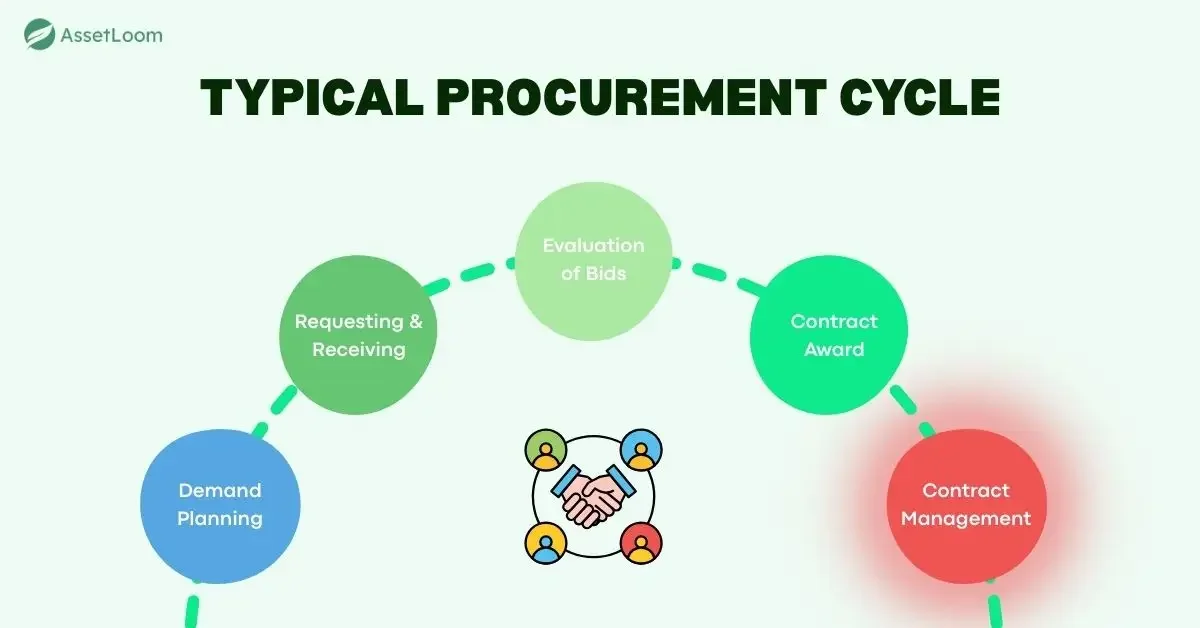
In the procurement lifecycle, contract management is commonly recognized as the fifth stage, following:
- Demand planning
- Requesting and receiving bids
- Evaluation of bids
- Contract award
- Contract management
This stage ensures that the contract is properly implemented, monitored, and completed, rather than ending once a supplier is selected.
Contract Management Lifecycle Explained
Contract management activities should not happen randomly. For most contract types, they should be managed in five main phases:
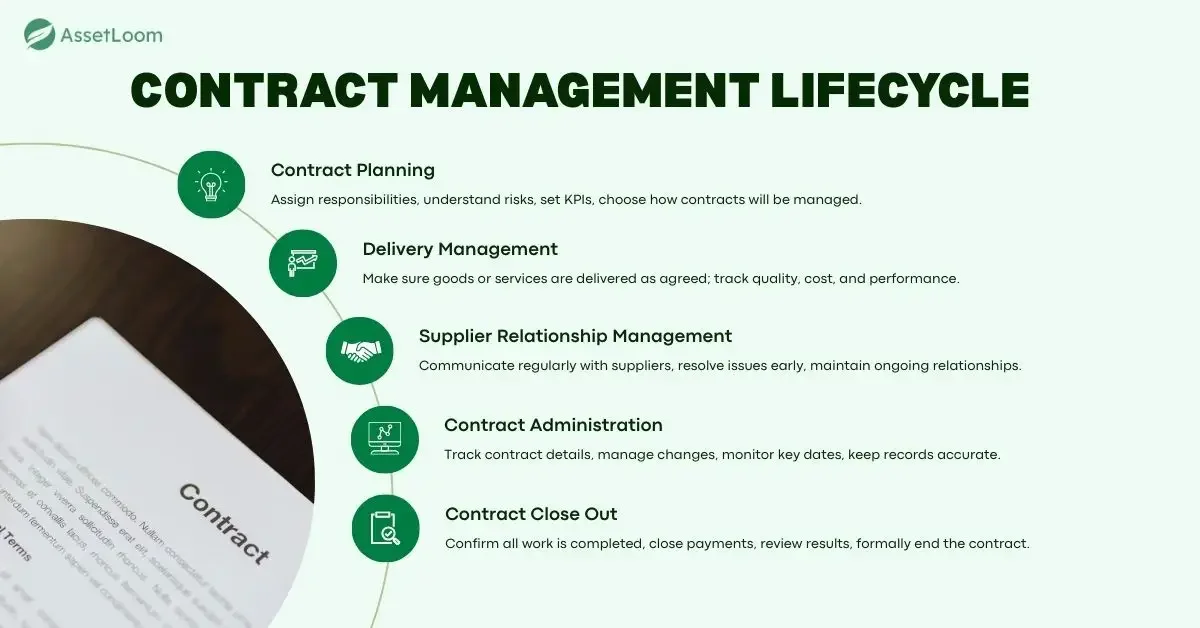
1. Contract Planning Phase
The Contract Planning Phase is where everything starts. This phase happens right after the contract is awarded and sets the foundation for how the contract will be managed. It’s important because it ensures everyone knows their roles, responsibilities, and expectations before delivery starts.
Key activities in the Contract Planning Phase include:
1.1. Assign Roles and Responsibilities
It’s important to define who is responsible for what during the contract’s lifecycle. This includes assigning roles for managing the contract, monitoring performance, handling payments, and addressing any issues. For example:
- Contract Manager: Oversees the contract to make sure it meets its objectives.
- Project Manager: Handles specific tasks or deliverables to ensure work aligns with the contract.
- Procurement Officer: Ensures the contract follows procurement policies.
- Finance Team: Tracks payments and ensures everything is financially aligned.
1.2. Analyze Risk
Every contract carries some level of risk. In this phase, the goal is to identify and assess the risks that could affect the contract. Risks can come from many areas, such as:
- Supplier-related risks (e.g., delays or failure to deliver)
- Financial risks (e.g., unforeseen cost increases)
- Legal risks (e.g., non-compliance)
- Operational risks (e.g., poor project management)
After identifying risks, the next step is to evaluate their likelihood and impact, and then create a plan to manage or reduce them. This is often captured in a risk register, which should be updated regularly.
1.3. Create a Contract Management Plan
This plan should outline how the contract will be managed throughout its lifecycle, including:
- Contract structure and terms: What’s included in the contract and what the key conditions are.
- Performance measures: What success looks like (e.g., timelines, quality, service levels).
- Monitoring: How performance will be tracked, using things like KPIs or SLAs.
- Roles and responsibilities: Who is responsible for what tasks during the contract.
- Communication: Ensuring clear communication across all parties involved.
1.4 Choose the Right Technology
Evaluating and selecting the right software to manage contracts should not be underestimated. Many organizations manage hundreds of contracts, such as vendor contracts, software agreements, and employee contracts, with spreadsheets. While spreadsheets may work at first, they quickly become hard to manage and easy to get wrong.
In many cases, organizations do not realize there is a much simpler and more reliable way to manage contracts. Manual tracking makes it easy to miss important details, especially renewal or expiration dates, which can lead to unexpected costs or service disruptions.
Dedicated contract management software helps centralize contract information and automate key processes. In IT-heavy environments, these capabilities are often part of an IT Asset Management (ITAM)** **system, where contracts are managed alongside software, hardware, and vendor data.
When choosing a contract management or ITAM tool, look for solutions that provide:
- Centralized Repository: A single, secure place to store all contracts and related documents, so nothing is lost and everyone works from the same information.
- Automated Workflows: Automatic handling of tasks like assigning owners, managing renewals, and tracking terminations.
- Real-Time Reporting: Clear views of contract status, key dates, and performance through simple dashboards and reports.
- Automated Alerts: Reminders for important contract dates (e.g., renewals or expirations).
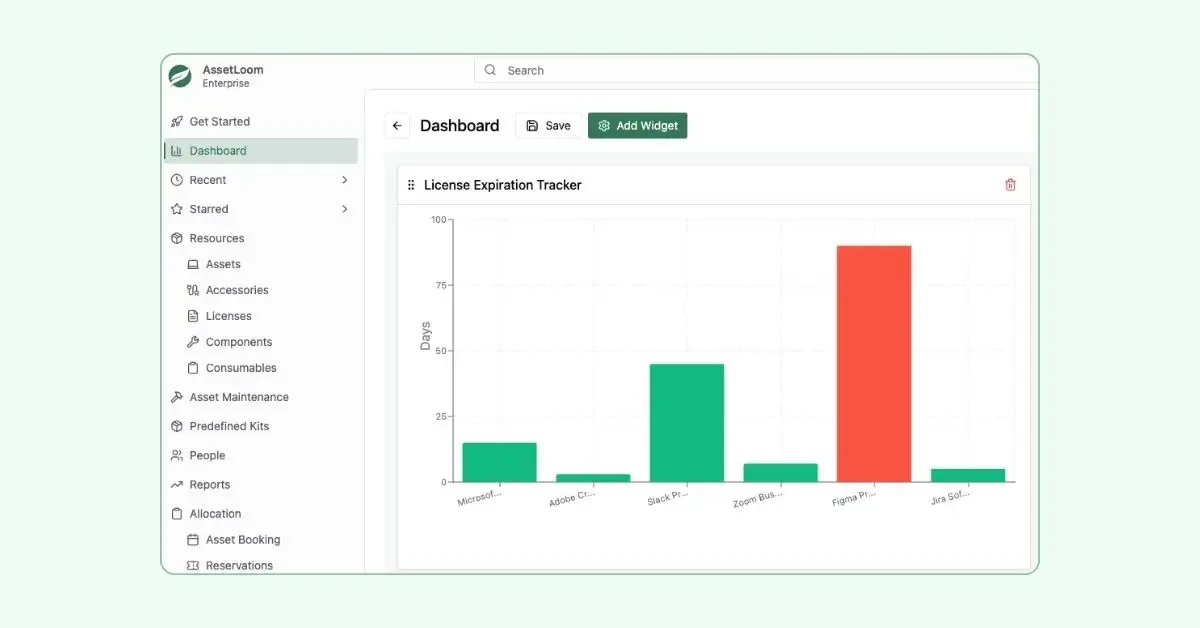
Software license expiration report in AssetLoom
Learn Top Tools for Managing Contract Expiration Reminders in 2025
2. Delivery Management Phase
The Delivery Management Phase ensures that the goods and services are delivered as agreed in the contract. The focus here is on maintaining performance, quality, and cost control.
Key activities in this phase include:
2.1. Arrange a Kick-Off Meeting
The Contract Manager should arrange a meeting with the supplier right after the contract is awarded. This meeting ensures that everyone understands their responsibilities and sets the tone for the work ahead. It’s an opportunity to align expectations and prevent misunderstandings.
2.2. Establish Service Levels
Clear expectations for service levels should be set with the supplier. This means defining the exact quality and quantity of what is being delivered. Having these details in writing helps avoid confusion later on.
2.3 Measure Quality and Quantity
As the contract progresses, it’s important to keep monitoring both the quality and quantity of what is being delivered. This monitoring should continue throughout the contract to ensure everything stays on track. If there are issues, they should be addressed quickly to avoid delays or non-compliance.
2.4. Ensure Value for Money and Socio-Economic Commitments
When managing contracts, two of the most important things to focus on are value for money and socio-economic commitments.
Value for money means getting the best deal possible. It’s not just about paying the lowest price. It’s about making sure you get the most benefit for what you’re spending. This means:
- Quality: Are you getting the quality of goods or services you expected?
- Cost: Are you paying a fair price for what you’re receiving? Is there a way to make the contract more cost-effective?
- Outcomes: Does the contract deliver the results that were promised? Is it helping you reach your goals?
At the same time, it’s important to monitor socio-economic commitments, such as job creation or supporting local businesses, to make sure these promises are kept.
3. Supplier Relationship Management Phase
The Supplier Relationship Management (SRM) Phase focuses on managing the working relationship between the organization and the supplier throughout the life of the contract.
A contract succeeds with clear communication, mutual understanding, and structured issue management. Identify and resolve issues early, and use clear escalation processes when operational-level problems persist.
4. Contract Administration Phase
The Contract Administration Phase focuses on managing the contract on a day-to-day basis to ensure it remains accurate, controlled, and up to date. This phase runs throughout the life of the contract and supports both delivery and supplier relationship management.
Contract administration involves keeping all contract information organized and making sure the contract is followed as agreed. This includes managing contract documents, tracking key dates, handling changes, and ensuring payments match the contract terms.
In practice, contract administration covers activities such as:
- Maintaining signed contracts, amendments, and related documents
- Tracking contract duration, renewals, and termination conditions
- Managing contract changes, extensions, or variations
- Recording approvals and decisions
- Ensuring invoices and payments align with the contract
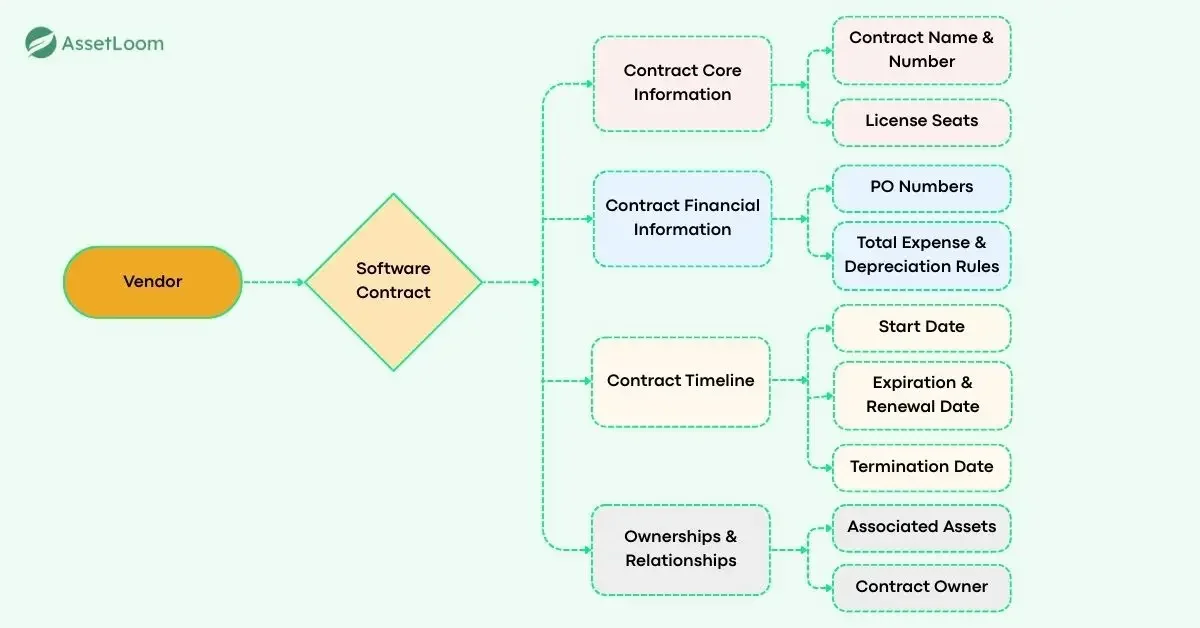
A sample of a typical software contract management workflow
With that in mind, choosing the right contract management tools as planned in phase 1 is of utmost importance.
5. Contract Close-Out Phase
The Contract Close-Out Phase takes place when a contract reaches its end, is terminated, or is no longer needed. The purpose of this phase is to formally close the contract and ensure all obligations have been completed.
Contract close-out ensures there is a clear and documented end to the contract. This helps prevent ongoing costs, unresolved issues, or uncertainty about contract status.
Key activities during contract close-out include:
- Confirming all goods or services have been delivered as agreed
- Ensuring all payments are completed, and no outstanding invoices remain
- Reviewing supplier performance and contract outcomes
- Documenting lessons learned for future contracts
- Archiving contract records for reference or audit purposes
To Sum Up
Contract management is about making sure contracts deliver what was agreed, from start to finish. It goes beyond signing documents and focuses on planning, monitoring, communication, administration, and proper close-out.
By following a clear contract management lifecycle, organizations can reduce risk, control costs, improve supplier performance, and avoid missed obligations. This applies to all types of contracts, including software and IT-related agreements.
Frequently Asked Questions (FAQs)
Q1: What is contract management in simple terms?
Contract management is the process of making sure a contract is followed from beginning to end. It ensures the agreed work is delivered, costs are controlled, risks are managed, and both parties meet their responsibilities.
Q2: When does contract management start?
Contract management begins after a contract is awarded. While procurement selects a supplier, contract management handles post-signing activities.
Q3: Is contract management only for legal or procurement teams?
No. While procurement and legal teams are often involved, contract management also involves IT, finance, operations, and end users. In IT environments, contract management is commonly handled by IT or IT Asset Management teams.
Q4: What is the difference between contract management and contract negotiation?
Contract negotiation focuses on agreeing on terms before signing a contract. Contract management focuses on managing the contract after it has been signed, including delivery, performance, renewals, and close-out.
Q5: Why is contract management important for IT and software contracts?
Software contracts often renew automatically, are usage-based, and involve ongoing costs. Without proper contract management, organizations may overpay, miss renewal deadlines, or face compliance risks. Good contract management helps control software spend and maintain visibility.
Q6: Can contracts be managed using spreadsheets?
Spreadsheets may work for a small number of contracts, but they become difficult to manage as contracts increase. Important dates, ownership, and changes can be easily missed. Dedicated contract management or ITAM software provides better structure, automation, and reliability.
Q7: What is value for money in contract management?
Value for money means getting the best overall outcome for the money spent. It considers not just price, but also quality, performance, and whether the contract delivers the expected results over time.
Q8: What happens during contract close-out?
Contract close-out ensures the contract is formally completed. This includes confirming all deliverables are done, payments are settled, performance is reviewed, and records are archived. For software contracts, it may also include ending access or reducing licenses.
AssetLoom is the IT Asset Operations Platform (AssetOps) that gives organizations total control over their hardware, software, contracts, and workflows. By unifying lifecycle management, financial optimization, governance, and automation, AssetLoom delivers visibility and operational control across the entire IT environment.