Why Software Asset Management Matters to Your Business?
Understand Software asset management - a strategic way to control software usage and prevent compliance risks.
Software has become the backbone of modern businesses, powering everything from internal collaboration to customer-facing services. Whether it’s communication tools, collaboration platforms, or specialized software for finance, marketing, or product development, software is essential to daily operations.
However, as businesses depend more on software, they face challenges like rising costs, compliance risks, and security gaps. This is where Software Asset Management (SAM) comes in to help organizations maximize their return on investment.
SAM is a strategic practice focused on tracking, optimizing, and securing software assets throughout their lifecycle. In this article, we’ll explore what SAM is, its key components, and how it fits into the broader IT Asset Management (ITAM) framework to support your organization’s success.
What is Software Asset Management?
Software Asset Management (SAM) is a structured process for monitoring, tracking, and optimizing software licenses and usage throughout an organization’s lifecycle.
SAM goes beyond just purchasing and installing applications. It includes understanding licensing models, ensuring compliance, and making sure that each software product aligns with the company’s broader goals.
SAM is an ongoing practice that requires collaboration across departments—IT, finance, legal, and procurement. This helps maintain accurate records of software entitlements and usage. When implemented effectively, SAM helps organizations avoid legal risks, cut unnecessary costs, and boost operational efficiency.
Key elements of software asset management
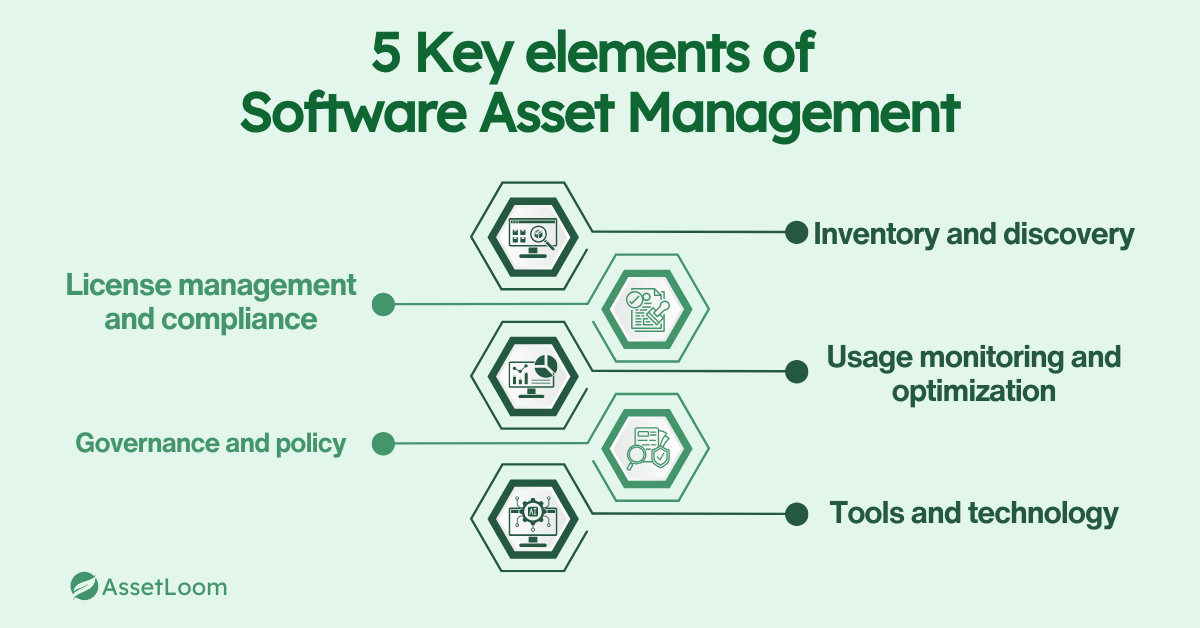
1. Inventory and discovery
Accurate visibility into all software in use is the foundation of Software Asset Management (SAM). This requires using discovery tools, either agent-based or agentless, that scan the network to detect installed software.
The data collected must be normalized, meaning it should follow consistent naming conventions and version numbers for clarity. Real-time updates are crucial, as software environments can change quickly when employees install or remove applications.
2. License management and compliance
License agreements can vary significantly among vendors. Some are perpetual, meaning the organization owns the software indefinitely, while others are subscription-based, with payments made monthly or annually.
Tracking software entitlements, such as purchases, contracts, and renewals, is essential to avoid legal issues and unexpected costs. Understanding the specific licensing rules of each vendor is crucial.
For example, companies like Oracle, Adobe, and Microsoft have unique licensing terms that require careful management to ensure compliance.
3. Usage monitoring and optimization
Once a software inventory is established, organizations can track usage patterns to identify underutilized licenses or “shelfware.” By measuring the frequency of use and ensuring inactive licenses are retired or reassigned, companies can optimize their software spending.
This process of reharvesting licenses saves money and simplifies future software purchases.
4. Governance and policy
Effective policies clearly outline the processes for software requests, deployments, and retirements. They define roles, establish standard procedures, and create a clear chain of accountability for all stakeholders.
Regular internal audits and policy reviews help ensure the organization stays prepared for external audits and vendor checks.
5. Tools and technology
Specialized SAM tools can automate tasks like discovery, license tracking, and compliance reporting. These tools often integrate seamlessly with existing IT Service Management (ITSM) and Configuration Management Database (CMDB) systems, providing a complete view of your organization’s software ecosystem.
As artificial intelligence (AI) and machine learning continue to evolve, SAM tools are increasingly capable of predictive analytics. Besides, they also help identify trends in software usage before they become costly issues.
Why is software asset management important?
For many organizations, software licenses make up a significant portion of their IT budget. Without proper management, it’s easy to overspend on redundant or overlapping applications.
Effective SAM helps businesses control costs by aligning software usage with actual needs. Maintaining accurate records and adhering to licensing terms also helps minimize legal risks.
Moreover, SAM plays a crucial role in organizational security. Outdated or unpatched software can expose the company to cyber threats. By keeping an accurate inventory and ensuring timely updates, organizations can reduce the risk of vulnerabilities.
When software usage is in line with policies and compliance requirements, businesses run more smoothly, employees are more productive, and service delivery becomes more reliable. These advantages give companies a competitive edge and allow them to reinvest savings into innovation and growth.
Comparing SAM with IT asset management (ITAM)
While both SAM and IT Asset Management (ITAM) focus on managing an organization’s technology resources, they have distinct scopes and specialized processes. While both SAM and IT Asset Management (ITAM) focus on managing an organization’s technology resources, they have distinct scopes and specialized processes. ITAM covers all technology-related assets such as hardware, software, network infrastructure, and cloud resources throughout their entire lifecycle, from acquisition to disposal.
In contrast, SAM is a subset of ITAM that focuses specifically on managing software licenses and ensuring compliance.
One key difference is in the nature of the assets: software is intangible and can be quickly provisioned, repurposed, or abandoned, while physical hardware typically follows a more predictable lifecycle.
Because of this, SAM requires a deep understanding of constantly changing licensing terms, vendor relationships, and usage metrics.
Despite their differences, both SAM and ITAM share common goals: cutting costs, managing risks, and ensuring proper governance. When SAM is integrated into a broader ITAM strategy, organizations gain a unified view of all IT assets, leading to better budgeting, improved policy enforcement, and enhanced efficiency.
How to make an effective SAM program
A Software Asset Management (SAM) program is a set of practices that organizations use to systematically manage all software assets. An effective SAM program helps you track and optimize software licenses, usage, and compliance throughout their lifecycle.
Here are some steps to help you build and maintain a successful SAM program:
- Secure executive buy-in: Demonstrate how SAM reduces financial and compliance risks while supporting broader organizational goals.
- Form a cross-functional governance team: Include stakeholders from IT, procurement, finance, legal, and security, each with clearly defined roles.
- Centralize and standardize software data: Store it in a single repository, enforce consistent naming conventions, and conduct regular data audits.
- Use a risk-based approach to licensing: Prioritize critical applications, align them with usage patterns, and explore flexible models like concurrent or subscription licenses.
- Foster collaborative vendor relationships: Leverage vendor intelligence, maintain proactive communication, and use data-driven negotiations for better contract terms.
- Conduct regular training and awareness programs: Ensure employees understand the financial, security, and legal consequences of software misuse.
- Adapt to evolving trends and regulations: Stay informed about changes in SaaS models, data protection laws, and emerging technologies like AI or containerization.
Conclusion
Software Asset Management (SAM) is crucial in today’s fast-paced digital world. With the rise of cloud-based software, subscription models, and stricter licensing rules, businesses must stay on top of their software to avoid costly compliance issues and unnecessary expenses.
By effectively managing software assets, companies can reduce costs, maintain compliance, and quickly adapt to changes in vendor policies or market conditions. When integrated with broader IT Asset Management (ITAM) practices, SAM helps organizations make smarter decisions, improve efficiency, and minimize risks.
Frequently Asked Questions (FAQ)
1. What is the difference between SAM and ITAM?
SAM focuses on managing software licenses, usage, and compliance, while ITAM covers all technology assets, including hardware, software, and cloud resources. While both aim to optimize resources and reduce costs, ITAM takes a broader approach by managing assets from acquisition to disposal, whereas SAM is specifically for software.
2. How can SAM save my business money?
SAM helps businesses avoid overspending by aligning software usage with actual needs, tracking underutilized licenses, and eliminating redundant software. It also prevents unnecessary purchases and minimizes compliance fines, leading to significant savings.
3. Why is SAM important for security?
Outdated or unpatched software can create security risks. SAM ensures your software is up to date and compliant with licensing requirements, reducing vulnerabilities and protecting your business from cyber threats.